If you are a MEPCO consumer planning to connect a solar system to the electricity grid, this MEPCO net metering guide explains the current process, eligibility, documents, metering, billing, and key 2026 rules. The rules have changed: NEPRA’s 2026 Prosumer Regulations use a net-billing arrangement, so new applicants should understand how imported and exported electricity are treated before investing in a system.
Table of Contents
What Is MEPCO Net Metering?
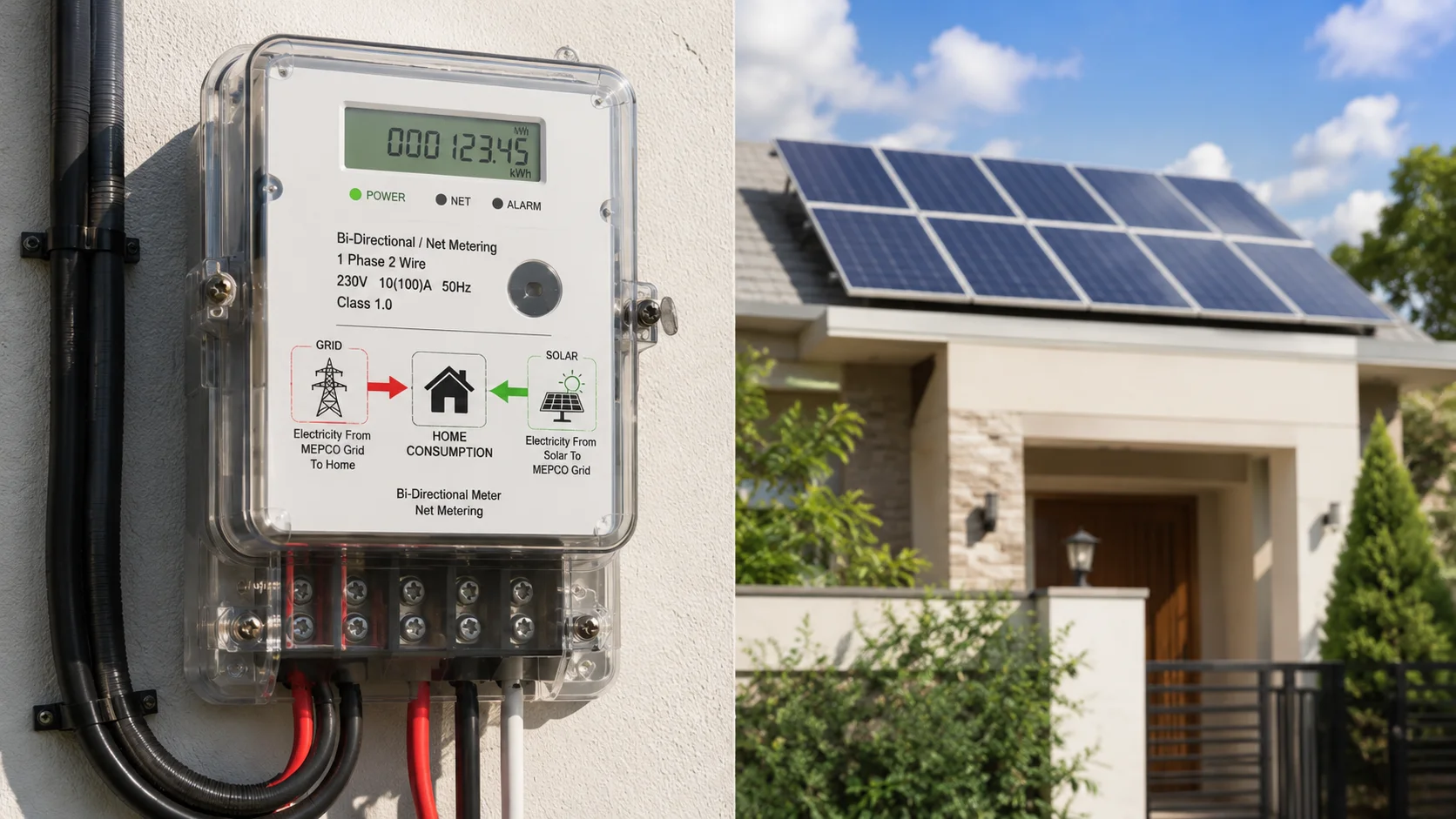
MEPCO Net Metering Guide traditionally allowed a consumer with a grid-connected renewable energy system to generate electricity, use it at the premises, and send surplus electricity to the grid.
However, the regulatory terminology and billing mechanism have changed in 2026. NEPRA notified the Prosumer Regulations, 2026 on February 9, 2026, replacing the earlier 2015 distributed-generation and net-metering regulations.
Under the current framework, a qualifying MEPCO consumer can become a prosumer by installing an eligible distributed generation facility and connecting it to MEPCO’s distribution system.
The regulations cover distributed generation using solar, wind, or biogas, with the facility defined as being up to 1 MW. The applicant must be a qualifying three-phase 400V or 11kV consumer, and the proposed generation capacity cannot exceed the sanctioned load.
Why the 2026 Change Matters
The biggest point for a new applicant is that electricity flowing in both directions is no longer simply treated as a one-for-one exchange.
Under the 2026 rules:
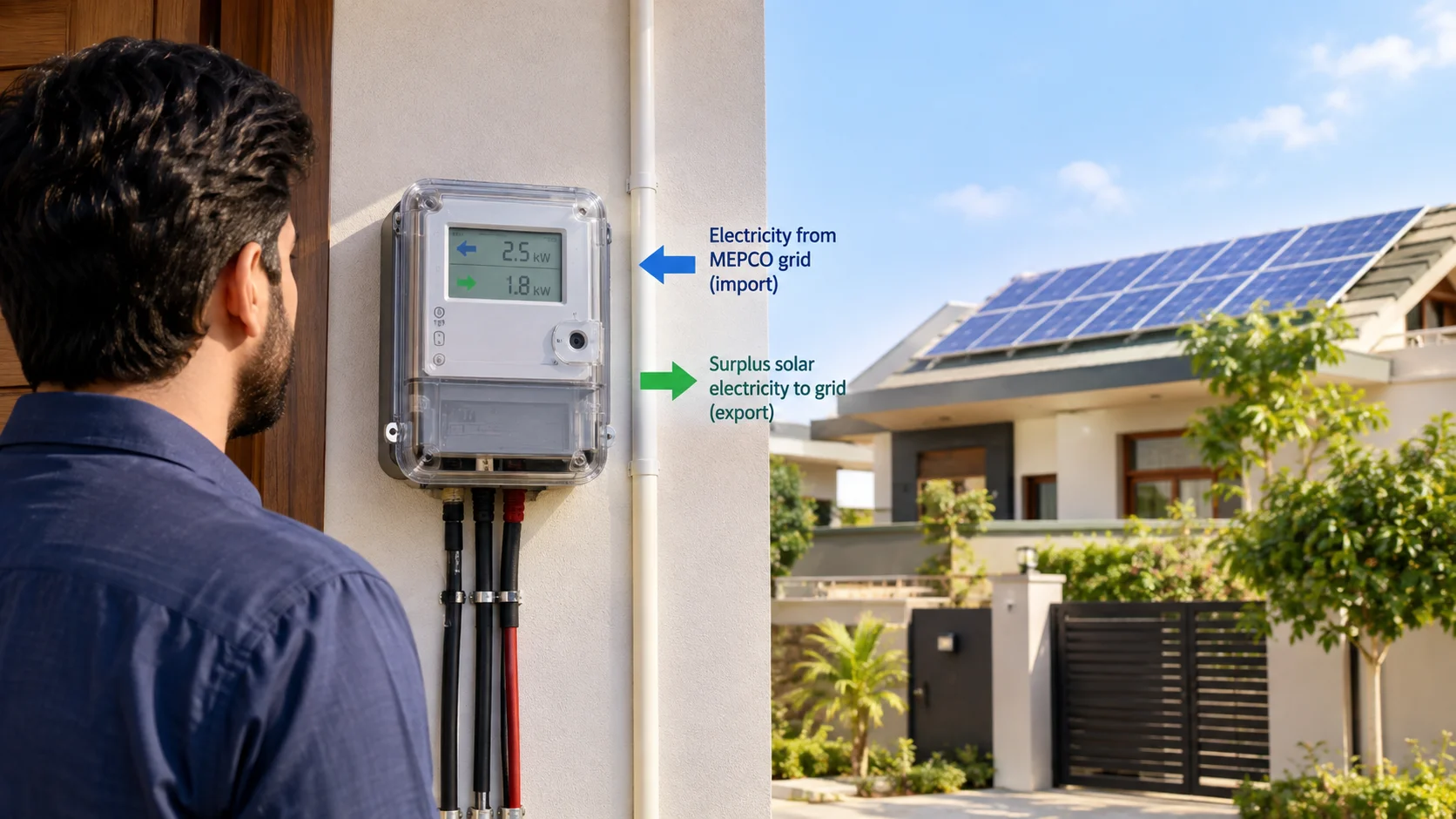
- Electricity supplied by MEPCO to the consumer is billed according to the applicable tariff.
- Electricity supplied by the prosumer to MEPCO is credited according to the national average energy purchase price.
- If the value of exported electricity exceeds the amount billed for electricity supplied by the licensee, the excess can be credited against the next billing cycle or paid by the licensee quarterly.
This makes self-consumption more important when planning a new solar system.
MEPCO Net Metering Rules in 2026
The current rules are officially called the NEPRA Prosumer Regulations, 2026. They apply to qualifying consumers who want to connect distributed generation to the distribution network.
A few requirements are especially important:
| Requirement | Current rule |
|---|---|
| Eligible connection | 3-phase 400V or 11kV consumer |
| Generation sources | Solar, wind or biogas |
| Maximum DG facility | Up to 1 MW |
| System capacity | Cannot exceed sanctioned load |
| Metering | Must measure electricity in both directions |
| Agreement term | 5 years |
| Renewable generation | Must meet applicable technical requirements |
The regulations state that the agreement between the prosumer and licensee has an initial term of five years, with renewal possible for additional five-year terms by mutual consent.
Who Can Apply for MEPCO Solar Net Metering?
A common misconception is that every electricity consumer can immediately apply for a solar export connection.
The current regulations define the applicant as a 3-phase 400V or 11kV domestic, commercial, industrial, agricultural, general-services, or single-point bulk-supply consumer of a licensee.
The proposed generation capacity also cannot be greater than the sanctioned load of the premises.
For example, if a consumer has a sanctioned load of 10 kW, installing a system with a proposed distributed-generation capacity above that sanctioned load would not meet the basic capacity requirement under the current regulation.
What About Single-Phase Connections?
If you currently have a single-phase connection, do not assume that you can simply install a bidirectional meter and begin exporting electricity.
MEPCO’s published net-metering checklist specifically states that the connection should be 3-phase, and advises applicants with single-phase connections to have the connection upgraded through the relevant SDO office.
MEPCO Net Metering Requirements
Before submitting an application, check your electricity connection and solar project information carefully.
You will generally need to deal with:
- A qualifying three-phase electricity connection
- Sanctioned load information
- Solar generation system details
- Approved technical equipment
- Interconnection equipment
- Metering arrangements
- Application and agreement documents
- CNIC and consumer information
- Previous electricity bill
- Technical drawings and system information
- Required inspection and installation documentation
MEPCO’s published checklist also identifies technical data for solar modules and inverters, schematic drawings, a single-line diagram, site-plan information, and installation/inspection certification among the application documentation.
Documents Required for the MEPCO Application
MEPCO’s published checklist provides a useful starting point for applicants.
Documents listed by MEPCO include:
- Standard distributed-generation application form
- Distributed Generation Interconnection Agreement
- Required NEPRA application documents
- CNIC copies of the applicant and witnesses
- Copy of the last paid electricity bill
- Technical information for solar modules and inverters
- Single-line diagram and schematic drawings
- Site plan showing the relevant disconnect equipment
- Installation/inspection certificate where applicable
- Agreement with the approved installer
- Additional company documents for corporate applicants
MEPCO also states that the name of the applicant and the name appearing on the electricity bill should match; if they do not, the consumer should have the name updated through the SDO office before proceeding.
Requirements can depend on the size and type of installation, so applicants should verify the current checklist before submitting documents.
How to Apply for MEPCO Net Metering
The application process can be understood as a series of stages.
Step 1: Check Your Existing Connection
First, confirm that your MEPCO connection meets the current eligibility requirements.
Check:
- Connection phase
- Voltage level
- Sanctioned load
- Consumer category
- Existing meter and wiring condition
The proposed distributed-generation capacity cannot exceed the sanctioned load under the 2026 regulations.
Step 2: Select a Qualified Solar Installer
Your installer should understand MEPCO’s technical and application requirements rather than treating the project as an ordinary rooftop solar installation.
MEPCO’s published checklist says the application is to be uploaded online by the approved installer and that the hard copy is to be submitted to the relevant MEPCO net-metering office or concerned field office according to the sanctioned-load authority.
Step 3: Prepare the Application Documents
Prepare your CNIC, electricity bill, system specifications, diagrams, agreement forms, and other required documentation.
Check the consumer name carefully before submission. A mismatch between the applicant’s name and the electricity bill can create avoidable delays.
Step 4: Submit the Application
Under the 2026 regulations, the application and required documents are submitted to the licensee.
The licensee is required to acknowledge receipt within five working days and tell the applicant whether the application is complete. If information or documents are missing, the applicant is given three working days to provide them.
Step 5: Technical Review
Once the application is complete, MEPCO performs an initial review to determine whether the proposed interconnection is technically feasible.
The regulations provide 15 working days for this initial review. If the proposed facility is not technically feasible, the licensee must communicate the reasons after completion of the review.
There is also a distribution-transformer limitation: an application cannot be entertained where distributed-generation capacity connected to the relevant transformer has reached 80% of its rated capacity.
Step 6: Agreement and Connection Charges
If the requirements are satisfied, the applicant and licensee enter into an agreement.
The licensee then issues a connection-charge estimate, including relevant interconnection and metering costs. The prosumer is responsible for the applicable interconnection costs under the regulations.
Step 7: Meter Installation and Commissioning
After the required payment, the licensee proceeds with installation and commissioning of the interconnection facility.
The regulations state that the licensee shall install and commission the proposed interconnection facility within 15 working days after payment of the demand notice.
Step 8: NEPRA Concurrence
The current framework also includes a concurrence process through NEPRA.
The licensee forwards the required application, agreement, fee evidence, and affidavit to the Authority. NEPRA may grant concurrence after receiving the required documents.
How MEPCO Net Billing Works
This is the section new solar applicants should understand before calculating their expected savings.
Imagine a household generates solar electricity during the day.
If the home is using appliances at the same time, some of the solar electricity can be consumed directly at the premises. Any excess can flow toward the grid through the approved interconnection.
When the household needs more electricity than its solar system is producing, electricity is supplied by MEPCO.
Under the 2026 framework, these two directions are valued differently:
Electricity imported from MEPCO → applicable consumer tariff
Electricity exported to MEPCO → national average energy purchase price
That is the core difference between the current net-billing arrangement and the simple idea of one-for-one unit adjustment.
A Simple Example
Suppose a household produces 600 kWh from solar during a billing cycle.
Of that production:
- 400 kWh is consumed directly in the home.
- 200 kWh is exported to the grid.
- The household also imports electricity from MEPCO when solar production is insufficient.
The important lesson is that the homeowner benefits most from using solar electricity directly when it is being generated, rather than designing the system solely around exporting large amounts of surplus energy.
The exact bill depends on applicable tariffs, imported electricity, exported electricity, taxes, adjustments, and the rate applicable to exported energy. Therefore, this example is for understanding the mechanism rather than predicting a specific bill.
Net Metering vs Net Billing
| Feature | Traditional net metering concept | Current 2026 framework |
|---|---|---|
| Main idea | Unit-based adjustment | Monetary/value-based credit |
| Imported electricity | Retail/applicable tariff | Applicable tariff |
| Exported electricity | Historically offset through netting | National average energy purchase price |
| Main planning focus | Production and export | Production + self-consumption |
| Regulatory name | Net metering | Prosumer Regulations / net billing |
NEPRA’s 2026 regulations expressly define the billing arrangement as net billing, while the older 2015 regulations were repealed when the new regulations came into force.
A Useful Strategy for New MEPCO Solar Buyers
Here is one practical point that is often missing from basic net-metering guides:
Do not size a new solar system only by asking, “How many units can I export?”
Instead, look at when your household consumes electricity.
For example, a home that regularly runs:
- Water pumps during daylight
- Washing machines during the day
- Air conditioning during sunny hours
- Refrigeration equipment
- Office equipment
- Other daytime loads
may be able to consume a larger share of its solar production directly.
That can be more valuable under a net-billing structure than producing a large surplus and relying heavily on export credits.
This does not mean everyone should install a smaller system. It means the system should be designed around the consumer’s load profile, sanctioned load, available roof space, budget, and expected electricity consumption.
Common MEPCO Net Metering Mistakes to Avoid
1. Using Outdated 2015 Information
Many websites still describe the old net-metering framework as if nothing has changed.
The 2015 regulations were repealed when the 2026 Prosumer Regulations came into force.
2. Ignoring Your Sanctioned Load
The proposed generation capacity cannot exceed the sanctioned load under the current rules. Check this before finalizing the system size.
3. Treating Exported Units as Equal to Imported Units
Under the current net-billing arrangement, imported and exported electricity are valued differently. Do not calculate your future bill by simply subtracting exported units from imported units.
4. Submitting Incomplete Documents
Missing CNIC copies, technical information, diagrams, bill-name mismatches, or other required documents can slow the process.
5. Buying Equipment Before Checking Technical Requirements
A solar system is not just a collection of panels. The inverter, protection equipment, metering, wiring, disconnect equipment, and interconnection design all need to satisfy applicable requirements.
MEPCO Net Metering Guide: What Should You Check First?
Before spending money on a solar installation, work through this checklist:
- Confirm your MEPCO connection type.
- Check your sanctioned load.
- Review your recent electricity consumption.
- Estimate your daytime electricity usage.
- Understand the current net-billing mechanism.
- Check the latest MEPCO application requirements.
- Choose an installer familiar with MEPCO procedures.
- Prepare the required documents.
- Confirm your consumer name matches your electricity bill.
- Verify technical equipment requirements.
- Understand connection and metering costs.
- Keep copies of your application and agreements.
Final Takeaway
A modern MEPCO net metering guide needs to go beyond the old advice of “install solar, get a bidirectional meter, and exchange units.”
As of September 2026, the governing framework is the NEPRA Prosumer Regulations, 2026, which introduced a net-billing arrangement. New applicants need to consider their connection type, sanctioned load, technical feasibility, documentation, interconnection costs, and the different treatment of imported and exported electricity.
For the most reliable information, check the latest regulatory notices from NEPRA and MEPCO’s published application requirements before submitting your project.
Frequently Asked Questions
1. What is MEPCO net metering?
MEPCO net metering refers to connecting a renewable-energy system, such as solar, to the MEPCO electricity network so electricity can be consumed at the premises and surplus generation can be supplied to the grid. Under the 2026 framework, the official regulatory arrangement is net billing under the NEPRA Prosumer Regulations.
2. Can a single-phase MEPCO consumer apply for net metering?
The current Prosumer Regulations define an applicant as a 3-phase 400V or 11kV consumer. MEPCO’s published checklist also states that applicants with single-phase connections should upgrade to three-phase through the relevant SDO office before proceeding.
3. What is the maximum solar capacity allowed under the 2026 rules?
The distributed-generation facility can be up to 1 MW, but the proposed capacity cannot exceed the applicant’s sanctioned load. Therefore, the maximum permitted system for an individual consumer may be lower than 1 MW depending on the sanctioned load.
4. How is exported solar electricity paid for under the new MEPCO system?
Under the 2026 net-billing arrangement, electricity supplied by the prosumer to the licensee is billed according to the national average energy purchase price. Electricity consumed from MEPCO is billed according to the applicable tariff.
5. How long is a MEPCO prosumer agreement valid?
The initial agreement term is five years from the commissioning date. The agreement can subsequently be renewed for additional five-year terms with mutual consent between the prosumer and licensee.
6. What should I check before applying for MEPCO net metering?
Check your connection type, sanctioned load, recent electricity consumption, consumer-name information, solar-system specifications, required documents, technical requirements, and the latest MEPCO and NEPRA rules. This helps prevent avoidable delays and allows you to evaluate whether the proposed solar system makes financial and technical sense.